This article will provide a brief overview of what a decade of effective therapy taught me about treating trauma and dissociation. These methods are not taught in university mental health training programs. Here is the understanding I synthesised from many years of university study, a decade of intense and productive therapy, and my memories of being a victim of extreme abuse at the hands of secret societies and military intelligence. This encompasses MK-Ultra, MK-Delta, ritual abuse, and mind control.
Trauma-Based Forced Dissociation
I coined the term Trauma-Based Forced Dissociation (TBFD) in 2019 to describe the conditioning stemming from ritual abuse and mind control techniques that the military and secret societies perpetrate against child subjects. Underpinning my proposed diagnosis of TBFD, my Dissociation of Learning Trauma Model explains the neurobiology of trauma and dissociation.
TBFD is systematically induced in the developing brain via applied classical and operant conditioning, and attachment theory. A standardised protocol of unethical hypnosis, sensory deprivation, torture, spinning, psychopharmacology, and rape is applied to the child from the earliest age. This creates a complex system of physically compartmentalised memories, experiences, personality traits, and abilities that may be triggered on command.
TBFD is distinct from recognised psychiatric diagnoses contained within the DSM and ICD. DID or Complex-PTSD typically organically result from repeated extreme developmental trauma events. It is normal for the brain to dissociate, repress memory, and fragment under sufficient stress. The result is a relatively small system of dissociated parts.
The military industrial complex studied this natural dissociation phenomenon under laboratory conditions, via MK-Ultra scientists, and weaponised it into the Western child soldier program called MK-Delta. Unlike DID, TBFD is a manufactured system of potentially hundreds and thousands of dissociated parts designed to perform certain tasks.
Military and esoteric understanding of brain anatomy and physiology differs from what is taught in modern psychology, psychotherapy, psychiatric, and even neuroscience training programs. The answers to what was done to military child victims, and how to undo the damage, are found in decades old, military-funded research publications. That research focused on hypnosis and psychedelics to begin with. It soon incorporated decades of studies into hemispheric lateralisation, sensory deprivation, mental imagery, EEG readings of brain activity, neurofeedback, electrocution, sexual perversion, and torture.
Dissociation of Learning Trauma Model
My theory underpinning TBFD is steeped in decades old state-dependent learning research. State-dependent learning was originally called “dissociation of learning.” It describes a phenomenon where whatever happens whilst in a dissociative state (altered state of consciousness) will be forgotten until the subject is returned to that original state.
Understanding this requires a fundamental comprehension of hemispheric lateralisation. Knowledge of hemispheric lateralisation is also essential to understanding the neurobiology of trauma and dissociation and why certain therapy techniques work.
The brain is divided into two halves – the left and right hemispheres – that are joined via a massive bundle of neurons called the corpus callosum. Each brain hemisphere performs different tasks and stores memory differently. The left side is auditory-sequential, is involved in simple language and math tasks, cannot process empathy, and anger is its only emotion. The left relies on repetition, or rote learning, for knowledge and skill acquisition. The left brain is verbal and gives context (a time, date, place stamp) to experiences, resulting in conscious or explicit memories that you can verbally and freely discuss. Importantly, the left brain is responsible for critical judgement and comparing sensory data against existing memory banks.
The right hemisphere is visual-spatial and responsible for more complex language and math tasks. The right brain prefers a wholistic, visual, and emotionally and somatically engaging approach to learning. The right brain also processes information inter-dimensionally. It learns and stores memory implicitly, at a non-conscious level. Hence the right brain is the seat of classical and operant conditioning, and it responds to subconscious cues or triggers like the smell of food, or the infamous Jaws movie score.
Military researchers referred to the left as the ‘dominant hemisphere’ and the right as the ‘non-dominant hemisphere.’ This is because during everyday normal activity the left brain is dominant while the right hums in the background. But that does not mean the right hemisphere stops functioning in its non-dominant state. It simply continues operating below the surface of consciousness. There, fuelled by emotion, it overrides conscious will and executes conditioned responses. Thus, fear of spiders, and emotional overeating will defeat reasoning every time until their triggers are exposed and extinguished.
During trauma events, the amygdala fear response is hyperactivated and the hippocampus suppressed. Trauma-experience sensory input bypasses left-brain contextualisation and is stored indefinitely as raw sensory data in the right hemisphere – like undigested food particles. When the trauma victim encounters a reminder of their trauma, this triggers a flashback, or a sensory re-experiencing of the incident. The person’s left brain will search the immediate environment for the source of the sensory input, and mistakenly time-place-date stamp that as the cause. So, the left brain falsely identifies a barking dog, nagging spouse, or yelling kids as the source of irritation.
Certain stimuli can bring the right hemisphere into dominance. There exist two types of arousal methods: high versus low. High arousal methods overwhelm the nervous system; these include being yelled at, verbally abused, loud rock music, religious revival meetings, torture, tribal dancing to loud drumming, and discordant music. Low arousal methods include hypnosis, trance, the twilight state, low chanting, low rhythmic drumming, and visualisation.
These low and high arousal methods induce an altered state of consciousness. Therefore, an ASC occurs when the right hemisphere is made dominant. The more the right brain comes forward and the left is suppressed, the deeper the ASC. Hooking a subject up to an EEG machine enables the observer to determine which state of consciousness the subject is in.
Our brainwaves can fire at different speeds depending on how alert we are. These firing rates are categorised, from slower to faster, as Delta, Theta, Alpha, Beta, and Gamma. Beta characterises a normal alert state. The slower the brain fires, the closer the brain moves toward a trance state, or an ASC. Alpha serves as the gateway to a trance state, induced in the therapy setting by progressive muscle relaxation and deep breathing. Theta indicates a trance state, while Delta is indicative of deep trance.
To access memories stored in the implicit (unconscious) memory system, and process trauma memories, a number of things must occur, including the following:
- The right hemisphere must be made dominant, and the left’s critical thinking capacity be suppressed.
- The hippocampus must be stimulated, so that the raw sensory data can be contextualised by the left brain before being stored into long-term conscious memory.
- The memory engram must be activated or triggered, which may occur by simply discussing it.
- The trauma memory must be sufficiently activated; this is achieved by simultaneously engaging as many of the sensory modalities that were activated at the time of the trauma event.
- The emotion must be stripped from the trauma memory.
- A novel learning (aka, a prediction error, or an element of surprise) must occur during processing of the trauma event. This might entail realising a surprising fact about the situation, like the child was not responsible for what happened. Or the client might visualise a different ending to the trauma event that completes whatever action the victim wishes they could have achieved at the time of the trauma experience.
Therapy techniques capable of facilitating this process include:
- Hypnosis
- EMDR
- Clay Field Therapy
- Art Therapy
- Guided visualisation
- Neurofeedback
- Somatic therapies
- Brain-spotting
- David Grande’s bilateral music.
The Safe and Sound Protocol can be a useful adjunct. This basically works by tightening the eardrum so that the brain shifts focus from low frequency predator sounds to being able to detect the high frequency sounds of voice prosody characteristic of, say, a soothing mother’s voice.
It is more effective to combine several of these modalities at once. For instance, after 10 years of engaging in these therapies, I achieved the final phase of parts-integration during a single therapy session in which I combined EMDR, Clay Field Therapy, bilateral music, and eyes-closed visualisation.
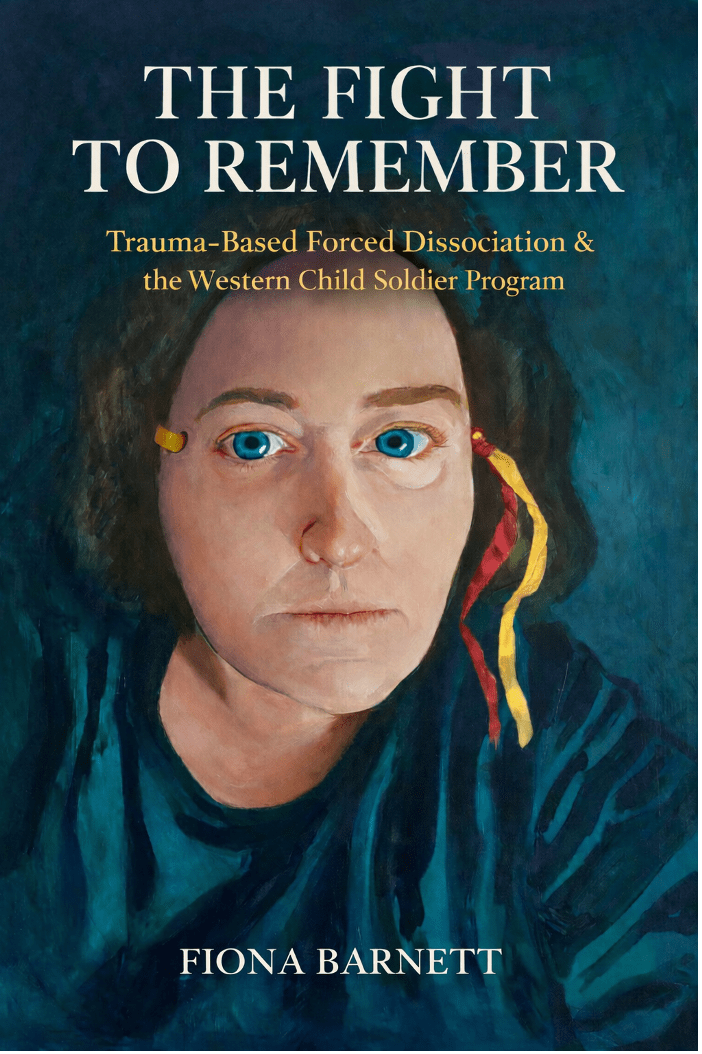
This summary is from my book, THE FIGHT TO REMEMBER: Trauma-Based Forced Dissociation & the Western Child Soldier Program, that I have been writing.
© Fiona Rae Barnett (10 March 2026)
 Fiona Barnett
You must be logged in to post a comment.